Showing posts with label education. Show all posts

Saturday, September 4, 2010

Dissertation defended

Defended. Done. Paperwork signed. Format corrections and final comments to final draft of dissertation are what is left to slog through. Tired. But a happy kind of tired. :)


Thank you all for your support throughout these years. I look forward to a short furlough home before heading on to whatever comes next.


-- The Old Fool
“If liberty means anything at all it means the right to tell people what they do not want to hear.” -George Orwell.
Creative Commons License
Blog - Musings of an Old Fool by Juan Lopez is licensed under a Creative Commons Attribution-Noncommercial-No Derivative Works 3.0 United States License.
Based on a work at lopezj4141.blogspot.com.
-

Tuesday, July 20, 2010

One step closer... :)

Hello, all. :) I had a great meeting with my professor this morning. We reviewed all of the final experimental data, those things that were left to do after the major experimental work was completed a couple of weeks ago. We spent nearly two hours going over everything, and he approved the work. I am finished with all my coursework, experimental work, qualifying examinations, and everything except for defending the dissertation. This is what the ABD status means – Ph.D. (ABD) (all but dissertation).

I will be working on getting my dissertation ready for defense over the next 2-3 weeks, and will be submitting for review to my committee. The review will likely take a couple of weeks at least, before we can bring the committee together for the defense. I hope to be defended sometime in the second half of August.

Again, thank you all for your love, support, friendship, and encouragement. This is a very exciting day…I have been smiling for a couple of hours now. :)

--
Sincerely,

The Old Fool, Ph.D. (ABD), E.I.T.


-- The Old Fool
“If liberty means anything at all it means the right to tell people what they do not want to hear.” -George Orwell.
Creative Commons License
Blog - Musings of an Old Fool by Juan Lopez is licensed under a Creative Commons Attribution-Noncommercial-No Derivative Works 3.0 United States License.
Based on a work at lopezj4141.blogspot.com.

Wednesday, November 4, 2009

John Galt's Wisdom

Some pearls of wisdom from the Ayn Rand character, John Galt, in his rousing speech at the end of Atlas Shrugged...

Excerpts:

* * * * *
"Man's mind is his basic tool of survival. Life is given to him, survival is not. his body is given to him, its sustenance is not. His mind is given to him, its content is not. To remain alive, he must act, and before he can act he must know the nature and purpose of his action. He cannot obtain his food without a knowledge of food and of the way to obtain it. He cannot dig a ditch - or build a cyclotron - without a knowledge of his aim and the means to achieve it. To remain alive, he must think.

But to think is an act of choice...............reason does not work automatically; thinking is not a mechanical process; the connections of logic are not made by instinct."

* * * * *
"If there are degrees of evil, it is hard to say who is the more contemptible: the brute who assumes the right to force the mind of others, or the moral degenerate who grants to others the right to force his mind. That is the moral absolute one does not leave open to debate.

I do not grant the terms of reason to men who propose to deprive me of reason.

I do not enter discussions with neighbors who think they can forbid me to think.

I do not place my moral sanction upon a murderer's wish to kill me. When a man attempts to deal with me by force, I answer him - by force. "

* * * * *
"The restriction they [the immoral, the irrational, the socialists, the new philosophers and mystics] seek to escape is the law of identity. The freedom they seek is freedom from the fact that A will remain an A, no matter what their tears or tantrums - that a river will not bring them milk, no matter what their hunger - that water will not run uphill, no matter what comforts they could gain if it did, and if they want to lift it to the roof of a skyscraper, they must do it by a process of thought and labor, in which the nature of an inch of pipe line counts, but their feelings *do not* - that their feelings are *impotent* to alter the course of a single speck of dust in space, or the nature of any actions they have committed.

Those who tell you that man is unable to perceive a reality undistorted by his senses, mean that they are unwilling to perceive a reality undistorted by their *feelings*. 'Things ar they are' are things as perceived by your mind; divorce them from reason, and they become 'things as perceived by your wishes.' "

"They proclaim that every man born is entitled to exist without labor and, the laws of reality to the contrary notwithstanding, is entitled to receive his 'minimum sustenance' - his food, his clothes, his shelter - with no effort on his part, as his due and his birthright.

To receive it - from whom? Blank-out.

Every man, they announce, owns an equal share of the technological benefits created in the world.

Created - by whom? Blank-out.

Frantic cowards who posture as defenders of industrialists now define the purpose of economics as 'an adjustment between the unlimited desires of men and the goods supplied in limited quantity.'

Supplied - by whom? Blank-out.

Intellectual hoodlums who pose as professors, shrug away the thinkers of the past by declaring that their social theories were based on the impractical assumption that man was a rational being - but since men are not rational, they declare, there ought to be established a system that will make it possible for them to exist while being irrational, which means: while defying reality.

Who will make it possible? Blank-out.

Any stray mediocrity rushes into print with plans to control the production of mankind - and whoever agrees or disagrees with his statistics, no one questions his right to enforce his plans by means of a gun.

Enforce - on whom? Blank-out.

Random females [now celebritards] with causeless incomes flitter on trips around the globe and return to deliver the message that the backwards people of the world demand a higher standard of living.

Demand - of whom? Blank-out."

* * * * *
"The man who refuses to judge, who neither agrees nor disagrees, who declares that there are no absolutes and believes that he escapes responsibility, is the man responsible for all the blood that is now spilled in the world. Reality is an absolute, existence is an absolute, a speck of dust is an absolute, and so is a human life. Whether you live or die is an absolute. Whether you have a piece of bread or not, is an absolute. Whether you eat your bread or see it vanish into a looter's stomach, is an absolute.

There are two sides to every issue: one side is right, and the other is wrong, but the middle is always evil. The man who is wrong still retains some respect for truth, if only by accepting a responsibility of choice. But the man in the middle is the knave who blanks out the truth in order to pretend that no choice or values exist, who is willing to sit out the course of any battle, willing to cash in on the blood of the innocent or to crawl on his belly to the guilty, who dispenses justice by condemning both the robber and the robbed to jail, who solves conflicts by ordering the thinker and the fool to meet each other halfway. In any compromise between food and poison, it is only death that can win. In any compromise between good and evil, it is only evil that can profit. In that transfusion of blood which drains the good to feed the evil, the compromiser is the transmitting rubber tube."

* * * * *
"As a basic step of self-esteem, learn to treat as the mark of a cannibal any man's demand for your help. To demand it is to claim that your life is his property - and loathsome as such a claim might be, there's something still more loathsome: your agreement. Do you ask if it's ever proper to help another man? No-if he claims it as his right or moral duty that you owe him. Yes - if such is your own desire based on your ownselfish pleasure in the value of his person and his struggle.

Suffering as such is not a value; only man's fight against suffering, is. If you choose to help a man who suffers, do it only on the ground of his virtues, of his fight to recover, of his rational record, or of the fact that he suffers unjustly; then your action is still a trade and his virtue is the payment for your help. But to help a man who has no virtues, to help him on the ground of his suffering as such, to accept his faults, his need, as a claim - is to accept the mortgage of a zero on your values."

* * * * *
"When you work in a modern factory, you are paid, not only for your labor, but for all the productive genius which has made the factory possible: for the work of the industrialist who built it, for the work of the investor who saved the money to risk on the untried and the new, for the work of the engineer who designed the machines of which you are pushing the levers, for the work of the inventor who created the product which you spend your time on making, for the work of the scientist who discovered the laws that went into the making of that product, for the work of the philosopher who taught men how to think and whom you spend your time denouncing.
...
Every man is free to rise as far as he's able or willing, but it's only the degree to which he thinks that determines the degree to which he'll rise.

Physical labor as such can extend no further than the range of the moment. The man who does no more than physical labor, consumes the material value-equivalent of his own contribution to the process of production, and leaves no further value, neither for himself nor others.

But the man who produces an idea in any field of rational endeavor - the man who discovers new knolwedge - is the permanent benefactor of humanity. Material products can't be shared, they belong to some ultimate consumer; it is only the value of an idea that can be shared with unlimited numbers of men, making all sharers richer at no one's sacrifice or loss, raising the productive capacity of whatever labor they perform.

It is the value of his own time that the strong of the intellect transfers to the weak, letting them work on the jobs he discovered, while devoting his time to further discoveries. This is mutual trade to mutual advantage; the interests of the mind are one, no matter what the degree of intelligence, among men who desire to work and don't seek or expect the unearned.

In proportion to the mental energy he spent, the man who creates a new invention recieves but a small percentage of his value in terms of material payment, no matter what fortune he makes, no matter what millions he earns.

But the man who works as a janitor in the factory producing that invention, recieves an enormous payment in proportion to the mental effort that his job requires of him. And the same is true of all men between, on all levels of ambition and ability.

The man at the top of the intellectual pyramid contributes the most to all those below him, but gets nothing except his material payment, receiving no intellectual bonus from others to add to the value of his time.

The man at the bottom who, left to himself, would starve in hopeless ineptitude, contributes nothing to those above him, but receives the bonus of all of their brains.

Such is the nature of the 'competition' between the strong and the wak of the intellect. Such is the pattern of 'exploitation' for which you have damned the strong.
...
You decided to call it unfair that we, who had dragged you out of your hovels and provided you with modern apartments, with radios, movies and cars, should own our own palaces and yachts - you decided that YOU had a right to your wages, but that WE had no right to our profits. that YOU did not want us to deal with your mind, but to deal, instead, with your gun. Our answer to that was: 'May you be damned!' Our answer cdame true. You are."

* * * * *
I only wish the BSG phrase could now resound: "So say we all."

Good night, and sleep well with dreams of rational thinkers surviving somewhere underground as the looters and new mystics of the "social" take over.


--
The Old Fool

“If liberty means anything at all it means the right to tell people what they do not want to hear.” -George Orwell.


Creative Commons License
Blog - Musings of an Old Fool by Juan Lopez is licensed under a Creative Commons Attribution-Noncommercial-No Derivative Works 3.0 United States License.
Based on a work at lopezj4141.blogspot.com.

-

Sunday, May 10, 2009

Bottled Water

Again, though all who may know me know how far from generally hippie Earth Day Prius-ey I am, I do think that it's the small choices in everyday life that can make all the difference...not gigantic government spending (to combat climate change, for example).

Great little slideshow for all you bottled water addicts out there:


Original Link

Make small changes in life - waste less, and the world changes. Don't ask for those extra napkins at the drive-thru, don't take more condiment packets than you are actually going to use, don't go for the bottled water - in fact, try to avoid the individually bottled drinks overall, use compact fluorescent bulbs in your home. Small, simple daily changes that when multiplied by the many hundreds of millions in this country, add up to gigantic differences. We don't need gigantic government spending programs to change the world for the better when we can simply be better stewards of our own resources and lives.

Saturday, April 18, 2009

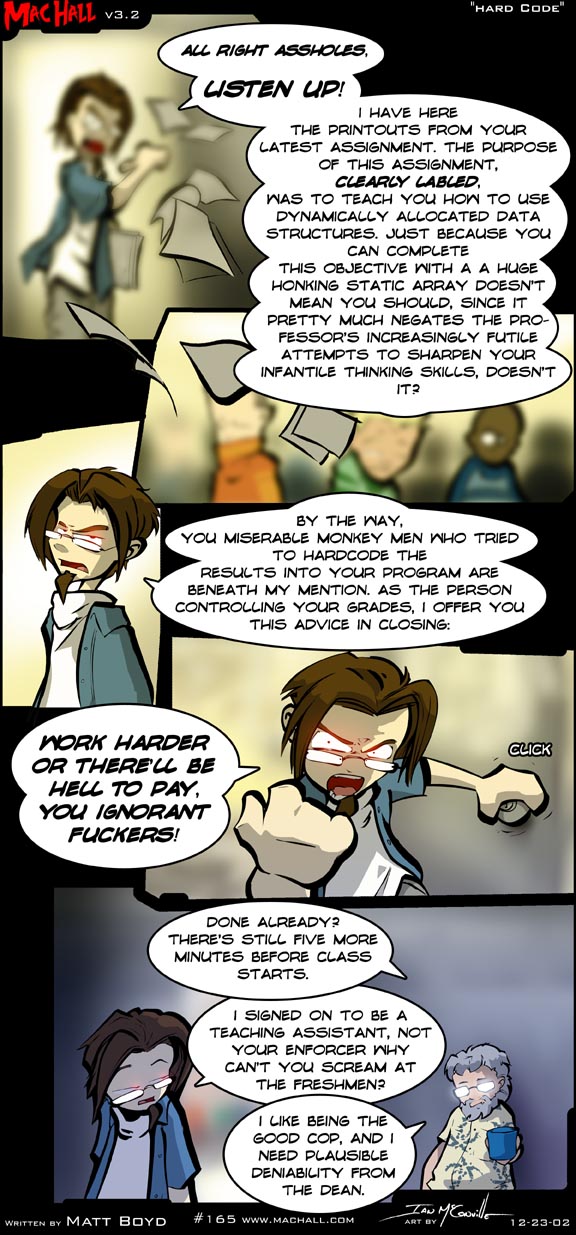
Mac Hall-Grading

A little salty in the language, but does the job well in being hilarious if you've ever graded. :)

From: http://www.machall.com/comics/20021223.jpg

Tuesday, April 7, 2009

In defense of freedom of speech and religion

A sobering discussion.

Speech at David Horowitz Freedom Center

I may not always agree with this guy, but this speech was certainly sobering and disturbing. We cannot, MUST not surrender our freedom of speech, religion, and free association to the thuggery of one-sided tolerance. Those who would decry this man over his lack of "tolerance" are unwilling to BE tolerant, or respect the laws in the countries they inhabit, given that God's law always trumps man's law.

We are seeing a resurgence of this kind of idiocy in American from my fellow Christians as well. Do a simple word substitution for deity/main prophets, and the difference in theocracy the man in the linked speech is decrying becomes IMMATERIALLY indistinguishable from the theocracy being advocated by the new Calvinist/Reformed/Fundamentalist wing of Christianity.

It is a pernicious cancer that is taking over the world - this return to the DARK AGES of full submission to a church authority of one form or another. I, for one, refuse to be one of the "useful idiots" that masquerades one-sided tolerance as progressive justice.

"The price of freedom is eternal vigilance" - T. Jefferson

"In the middle ages of Christianity opposition to the State opinions was hushed. The consequence was, Christianity became loaded with all the Romish follies. Nothing but free argument, raillery & even ridicule will preserve the purity of religion." - T. Jefferson

“If liberty means anything at all it means the right to tell people what they do not want to hear.” - G. Orwell

"A nation which can prefer disgrace to danger is prepared for a master, and deserves one!" A. Hamilton

"The greatest threat to mankind and civilization is the spread of the totalitarian philosophy. Its best ally is not the devotion of its followers but the confusion of its enemies. To fight it, we must understand it." A. Rand

"War is an ugly thing, but not the ugliest of things. The decayed and degraded state of moral and patriotic feeling that thinks that nothing is worth war is much worse. The person who has nothing for which he is willing to fight, nothing which is more important than his own personal safety, is a miserable creature and has no chance of being free unless made and kept so by the exertions of better men than himself." J. Stuart Mill

"The things that will destroy America are prosperity at any price, peace at any price, safety first instead of duty first, the love of soft living and the get rich quick theory of life." T. Roosevelt

"Guard with jealous attention the public liberty. Suspect everyone who approaches that jewel. Unfortunately, nothing will preserve it but downright force. Whenever you give up that force, you are ruined." P. Henry

On the language of one-sided tolerance for the useful idiots:

"But if thought corrupts language, language can also corrupt thought." G. Orwell

'Political language — and with variations this is true of all political parties, from Conservatives to Anarchists — is designed to make lies sound truthful and murder respectable, and to give an appearance of solidity to pure wind." G. Orwell

And the most resonant quote, and most damning of our current Chamberlain-esque appeasement is:

"They that can give up essential liberty to obtain a little temporary safety deserve neither liberty nor safety." Benjamin Franklin

SUBMISSION TO GOD IS A PERSONAL CHOICE, AND SHOULD NEVER, NEVER, NEVER BE DICTATED, DEMANDED, OR IMPOSED BY ONE MAN UPON ANOTHER.

Monday, March 2, 2009

Designer Babies

BBC - Designer Babies from IVF

Pop quiz.

1) Do you know the meaning of the word "eugenics"?
2) How far from the definition of eugenics is this new offering at the IVF clinic?
3) Who gets to decide what makes a human being "undesirable", which is a necessary definition if one decides what IS desirable?
4) Can you name 3 historical tragedies that are a result of embracing the idea of "desirable/undesirable" human beings?

This is one of the reasons that the study of ethics should be an absolute requirement in all college-level careers. It should be a requirement at the graduate level for all medically-related careers (such as my own biomedical engineering). It is a ghastly oversight that ethics/medical ethics/biomedical ethics are at best elective courses for most students in my field. It is even worse that many of my colleagues are bored silly by ethics courses/seminars/discussions. I've attended seminars and left hearing most of the people around me grumbling about having to have sat through so much "philosophy hooey, after all, we're scientists, not philosophers". This kind of density or willful ignorance of how ethics applies to one's own field of work, whatever it may be, is especially egregious in the medical and biomedical fields. 

Other news examples of the need for ethics education and discussion to be on the forefront of medical and biomedical training? Octomom. John and Kate +8. Baby bagged and dumped alive from botched abortion.

And these are only a few examples from ongoing media events in 2009 alone. We are surrounded by ethics-related decisions every day of our lives. In my own opinion, only those who wish to not be bothered with thinking too deeply would consider ethics to be a "minor" part of life's education needs.

Tuesday, February 17, 2009

Thoughts on the current state of education

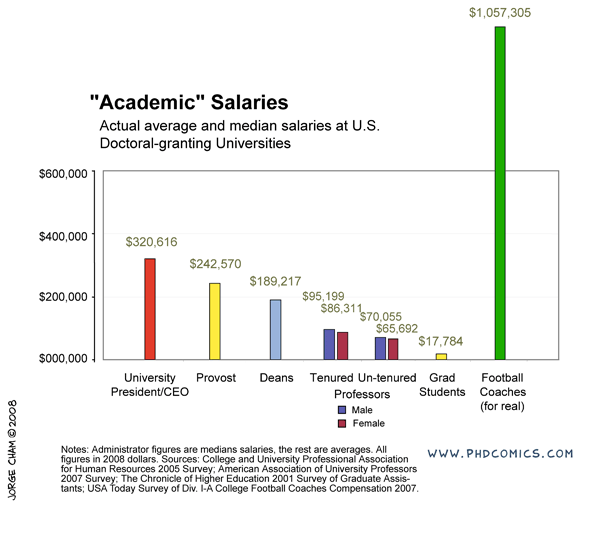
After the sadness induced by the following comic on PhComics -

http://www.phdcomics.com/comics/archive/phd102008s.gif

- I posted the following thoughts on two of Scott Adam's thought experiments from his daily blog:

First, on a post he made on Education Rankings,

http://www.dilbert.com/blog/entry/education_ranking/

I would have to strongly agree with many of the people making the point about critical thinking. As a Ph.D. candidate in engineering, just because my math and science skills have been more "important" to the coursework does not mean that the time I spent studying literature, history, political science, etc. were completely pointless. Rather, this entire process was meant to generate an individual who was more capable of critically evaluating concepts and new ideas, hopefully becoming a more productive member of society. I would argue that the level of science and mathematics expected from a High School student, or even most general university-level degrees will not make rocket scientists out of our students (pardon the pun). Instead, when applied correctly, these courses will contribute as much as literature, rhetoric, history, etc to generating a cogent, balanced, useful citizen. What we have today is a sad dearth of thinking citizenry, most so lazy they'd rather let a talking head on the television or favorite blog make the decisions for them.

I answered a similar question on LinkedIn about the Texas SAT scores, regarding why the scores continued to slip even though spending had dramatically increased (~40%). I believe the answer also applies well to the post you made here:

-----------------

Several great points have been made here already by the other posters.

First on my list has got to be the level of teaching that goes on at home, and how involved parents are in the educational process. We cannot expect to simply drop off our children and have them come back to us well educated. Education is an ongoing, immersive, total experience that continues throughout a person's life - and to a much larger degree during the formative years. If there is a lack of interest in learning, education, or advancement in the home, we can hardly expect our students to develop these interests on their own. The value that parents place on a good education is often reflected in the attitudes of the students themselves. Obviously there can be extremes that are counter-productive, but those are difficult to be rid of in any case. We need to bring the average parental involvement and interest UP.


Second, we have developed a culture that relies too much on "feeling good about ourselves", while completely ignoring the fact that EARNING the accomplishment is a huge reward in and of itself. We have way too many parents howling that their little special one didn't score top marks, when those marks were simply not earned. Teachers get put under tremendous pressure to make everyone appear to be the same honor-roll success story, or pass a certain exam (the "teaching the test" argument), and are left powerless to truly educate our children in a broader "critical thinker" sense.

Third, we have become a culture that has an attention span of about 12 second (hyperbole, but close enough). If we don't present something with immersive and constant pizazz, it must not be worth the attention. Unfortunately, many of the accomplishments in education require HARD WORK. Now, teachers may find creative ways to make the hard work seem more interesting, but we can never make it easy. It is the process of working for it and achieving that is a huge part of generating a successful student.

We culturally find it very difficult these days to make people work hard, and then face the cold reality that they may not have been as successful as another. I don't believe in "bell curves", but without the accomplishment of a superior grade and achievement meaning something, we sap the incentive for students to pursue these achievements with all the hard work and determination that they actually take. The emerging movement to change the color of a teacher's pen so that the students are less "emotionally affected" when they get corrected is still a bizarre concept to me. What the students should be working towards is reducing the number of these marks by improving their work, not worrying about whether they feel depressed about the color on the page.

If we do not wake up to the fact that we need to generate adults who can think critically rather than simply regurgitate prepackaged answers on a multiple choice exam, we will find ourselves in an intellectual recession that may be difficult or impossible to reverse. This is only anecdotal to me when I have taught courses, but the classical "word problem" lack of capacity in our students seems to come across loud and clear. If I present a question that simply requires multiple choice, fill in the blank, or a purely mathematical solution, many of my students do well. But if I present the problem as a real-world example from which they need to extract relevant information, discard the irrelevant, make assumptions, and explain their reasoning, I am almost always sorely disappointed. This kind of thinking and reasoning ability is absolutely essential in all walks of life, and yet we are producing answer machines rather than thinkers.

------------------------------------------

Second, on the follow-up post he made regarding practical education:

http://www.dilbert.com/blog/entry/unlearned_skills/

After reading this follow-up post of yours, Scott, I do have an addendum to my comments on education I made to your previous post - having a teacher who is closely connected to the students, and able to make the topics relevant is extremely important. I owe my engineering career to a very timely intervention by just the right teachers at just the right times. One example: right about when math was becoming too abstract and pointless to me (trig in high school), a teacher spotted my growing frustration and helped me see how trig could describe many things in the world around me - vibrations, signals, etc., etc. It didn't take much of this "practical" approach to make the whole subject relevant to me again. We were able to continue studying the abstract concept, but the few relevant examples were supremely important in making the subject both palatable and meaningful.

In my own teaching, I find the hands-on application of knowledge to be an absolute necessity, usually in the form of some project that extends beyond a simple homework assignment. It is difficult to motivate students to do the extra work these days, but I believe that when they do, the benefits are immense. Real-world application of theoretical abstracts are some of the best ways to cement concepts in the mind of a student. One of the additional benefits of real-world applications is the harsh reality that there are real problems and unexpected Murphy intrusions to anything that is attempted. No matter the subject they are working on, they will have to draw from more than one knowledge area to be successful.

It is not enough to generate critical thinkers, but we must be able to generate purposeful, intelligent, and cognizant people able to operate in the real world. "Ivory tower"-type critical thinking skills without the link to practicality are much less important to me. Throughout my engineering career and education I have discovered that the teachers I enjoyed the most and learned the most from were teachers that had gone through career evolutions that involved non-academic jobs at some point in their post-baccalaureate careers. The vast difference in having a teacher that could relate the abstract to a real-world problem, an on-the-job experience, or an interesting example versus one that had never left the comfortable confines of the education environment was impressive enough to encourage me to work in the "real world" for a few years before pursuing my Ph.D. and teaching goals. One additional example: when our engineering project management course was taught, the teacher spent a week discussing mortgages and loans, explaining how we needed to take our applied economics and be able to use it not only in engineering business decisions, but also in our own personal lives and finances. The tips and knowledge gained there were extremely $$$ valuable $$$ when I negotiated my first new car and home loans.

I reiterate my previous post's assertion, however, that we cannot take the hard work and abstraction completely out of the education equation. An integral part of learning is to learn how to deal with complex abstractions, and you cannot have a complete educational process that focuses solely on a "practical-based approach". Learning and achievement are meant to be difficult - students have to push and stretch to reach goals that are unreachable without the appropriate effort.

-------------

As an addendum after many people commented it was not only a teaching problem:

Parental involvement is a MUST. Without parents interested in their children learning, the children are left to muddle through life on their own and are at the mercy of the unionized bad-teacher-retaining education system. I did not learn to read in school, I learned to read at home.

When I was 2-1/2 years old, my baby brother was born. For the first 6-9 months of my brother's life, my mother would put him down for a nap, and then to keep me quiet would read to me for an hour or two. Always the teacher, my mother would run her fingers along under the words she was reading, drawing my eye's attention to the words she was saying.

After the first many months, I had memorized entire books of my favorite stories that I made my poor and Mother Theresa-esque patient mother read over and over again. However, a few MORE months of this, and I found myself reading along. Granted, very simple children's books, but still...reading. By the time I reached the "sound it out" phase in school, I was reading my favorite stories on my own. That early love of reading is something that has never left me, and contributed greatly to my long-term education.